Getting Started with Pyrefly Tensor Shapes
This page walks you through configuring Pyrefly for tensor shape checking and getting your first shape-annotated code running.
Installation
Tensor shape checking requires shape-aware stubs to be available through normal import resolution. Install them from PyPI:
pip install pyrefly-torch-stubs
pyrefly-torch-stubs is a PEP 561 stub-only package: it carries type
information for PyTorch, and leaves the runtime torch package alone. PyTorch's
own type stubs don't carry shape information, so these stubs take precedence
over them and provide shape-aware versions (e.g., nn.Conv2d.__init__ that
captures kernel size, stride, and padding as type-level values, and a forward
that computes the output spatial dimensions).
Installing it also pulls in pyrefly-shape-extensions, which provides the
shape_extensions package. shape_extensions exports Int — the bridge
between runtime integer values and type-level symbols. Both packages are
versioned in lockstep with Pyrefly.
Tensor shape support is enabled automatically when Pyrefly can resolve the
shape_extensions package, so nothing else needs configuring, as long as
Pyrefly resolves imports against the
Python environment you installed
into.
Checking against a local copy of the stubs
The stubs also live in Pyrefly's source tree under
tensor-shapes/,
which is where to work if you want to read or modify them. Copy that directory
into your project and point search-path at the two package directories inside
it. The paths are relative to the location of your pyrefly.toml (or of your
pyproject.toml, if you configure Pyrefly under [tool.pyrefly]):
search-path = [
    "tensor-shapes/pyrefly-torch-stubs",
    "tensor-shapes/pyrefly-shape-extensions",
]
A copy that lives inside your project is also checked as project code. The stubs
use PEP 696 type parameter defaults (class Conv1d[..., S: IntVar = 1]), which
Pyrefly parses only under python-version 3.13 or later, so checking them under
an earlier version reports:
ERROR Cannot set default type for a type parameter on Python 3.12 (syntax was added in Python 3.13) [invalid-syntax]
Either raise the version Pyrefly checks against. python-version sets the
version your code is checked for; it does not change the interpreter your code
runs on:
python-version = "3.13"
Or, if your project targets an earlier version and you don't want to change how
your own code is checked, exclude the copy from checking instead. Imports still
resolve through search-path:
project-excludes = ["tensor-shapes/**"]
Imports and runtime considerations
Python evaluates type annotations at runtime by default. This is a problem
for tensor shape annotations because Python's built-in typing.TypeVar
doesn't support arithmetic — expressions like D // NHead in an annotation
will raise TypeError when the annotation is evaluated. There are two ways
to avoid this:
Option 1: from __future__ import annotations (recommended)
Adding this import at the top of the file defers evaluation of all annotations, so shape arithmetic never executes at runtime:
from __future__ import annotations

import torch
import torch.nn as nn
from torch import Tensor
from shape_extensions import Int
This works with both old-style and new-style generics (PEP 695
class Foo[T] syntax).
assert_type during development: You can use assert_type while
porting to verify shapes via pyrefly check. Once you're done, remove the
assert_type calls — each one corresponds to an IDE inlay type hint that
shows the same information permanently. Pyrefly catches shape errors
through your function signatures and return types regardless.
Note that assert_type forces evaluation of its type argument, so the
file will crash if you try to run it with assert_type calls still
present. This is fine — just remove them when the port is complete.
You can also guard Tensor and Int under TYPE_CHECKING if you prefer
to keep shape imports invisible at runtime:
from __future__ import annotations
from typing import TYPE_CHECKING

import torch
import torch.nn as nn

if TYPE_CHECKING:
    from torch import Tensor
    from shape_extensions import Int
Option 2: shape_extensions.IntVar (runtime-compatible)
If you need annotations to evaluate at runtime (e.g., for runtime shape
validation or keeping assert_type in production code), import
shape_extensions directly. The package patches
torch.Tensor, nn.Conv2d, and other torch classes to accept subscript
syntax at runtime without crashing. It also provides a IntVar that
supports arithmetic (N + 1 returns self instead of raising TypeError).
Use old-style generics with shape_extensions.IntVar:
from typing import assert_type

import torch
import torch.nn as nn
from torch import Tensor
from shape_extensions import Int, IntVar

N = IntVar("N")
M = IntVar("M")

class Linear(nn.Module):
    def __init__(self, n: Int[N], m: Int[M]):
        ...
PEP 695 new-style generics (class Foo[T]) automatically use
typing.TypeVar internally, which doesn't support arithmetic — so this
option requires old-style generics.
Open this example in the Pyrefly sandbox — Experiment with Int arithmetic, TYPE_CHECKING imports, and building typed tensors — no setup required.
Hello world
Here's a minimal example to verify everything works. This example uses
Option 1 (from __future__ import annotations) since it's the simplest
setup. We skip assert_type — instead, run pyrefly check and use your
IDE's inlay type hints to verify shapes.
Create a file hello_shapes.py:
from __future__ import annotations

import torch
import torch.nn as nn
from torch import Tensor
from shape_extensions import Int, IntVar


class TwoLayerNet[InDim: IntVar, HidDim: IntVar, OutDim: IntVar](nn.Module):
    def __init__(
        self,
        in_dim: Int[InDim],
        hid_dim: Int[HidDim],
        out_dim: Int[OutDim],
    ):
        super().__init__()
        self.fc1 = nn.Linear(in_dim, hid_dim)
        self.fc2 = nn.Linear(hid_dim, out_dim)

    def forward[B: IntVar](self, x: Tensor[[B, InDim]]) -> Tensor[[B, OutDim]]:
        h = self.fc1(x)          # pyrefly infers: Tensor[[B, HidDim]]
        return self.fc2(torch.relu(h))
Run pyrefly check hello_shapes.py. You should see no errors — pyrefly
infers the shapes through the nn.Linear calls.
If you're using an IDE with Pyrefly's language server, you'll see inlay
type hints showing the inferred shape of h as Tensor[[B, HidDim]]
without needing any assert_type calls.
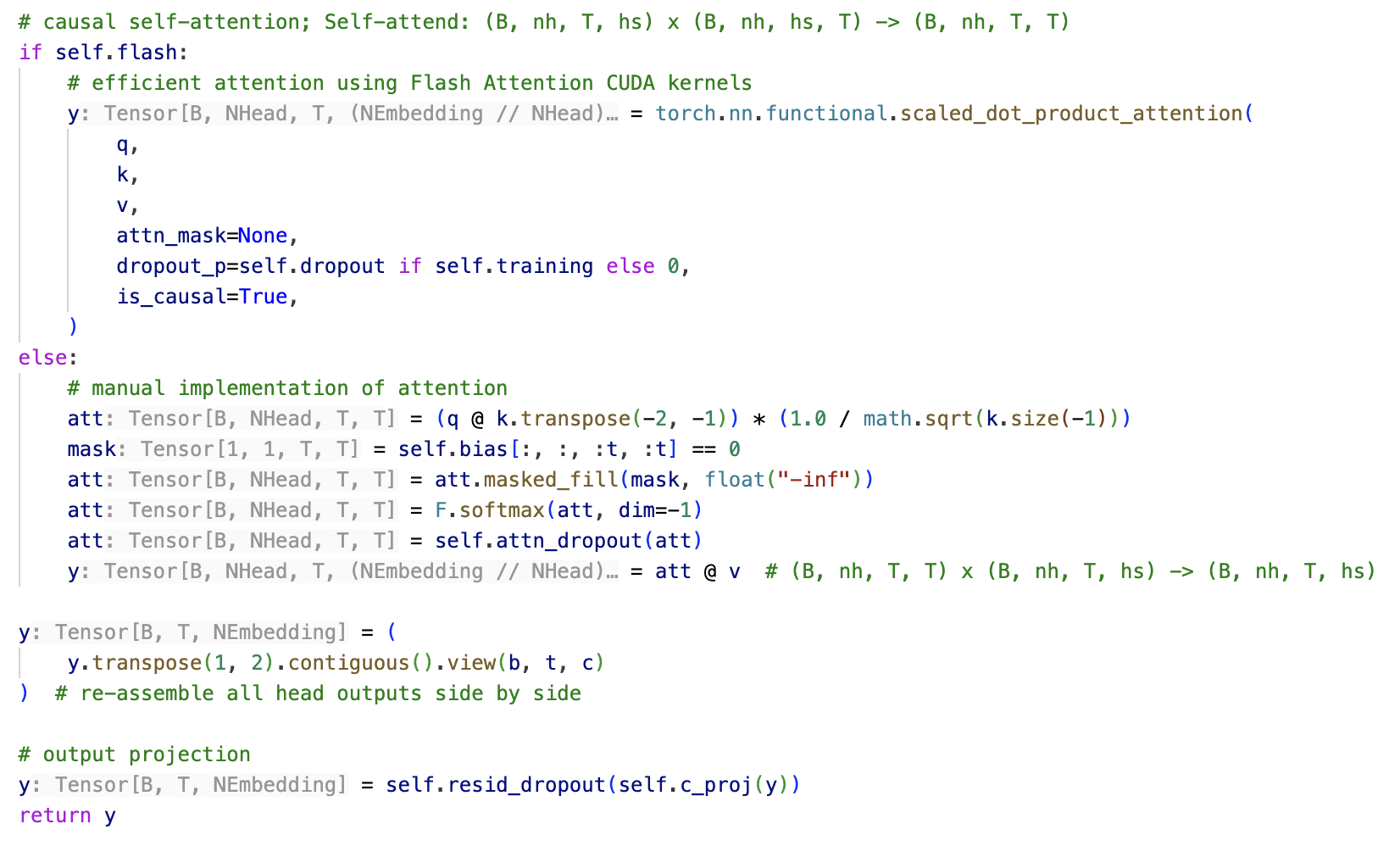
Inlay hints in action
Here's what inlay hints look like on a real model (NanoGPT). The MLP module shows shapes flowing through linear layers and activations:
![NanoGPT MLP module with inlay type hints showing Tensor[B, T, 4 * NEmbedding] after the expansion layer](/img/tensor-shapes/nanogpt-mlp.png)
The forward method signature shows how x.size() unpacks into typed
dimensions:
![NanoGPT forward signature with x.size() unpacking to b: Int[B], t: Int[T], c: Int[NEmbedding]](/img/tensor-shapes/nanogpt-forward-signature.png)
And the attention module, where view/transpose reshapes for multi-head attention are fully tracked:
![NanoGPT attention QKV computation with inlay type hints showing Tensor[B, NHead, T, NEmbedding // NHead]](/img/tensor-shapes/nanogpt-attention-qkv.png)
The full attention body, including both flash and manual paths: