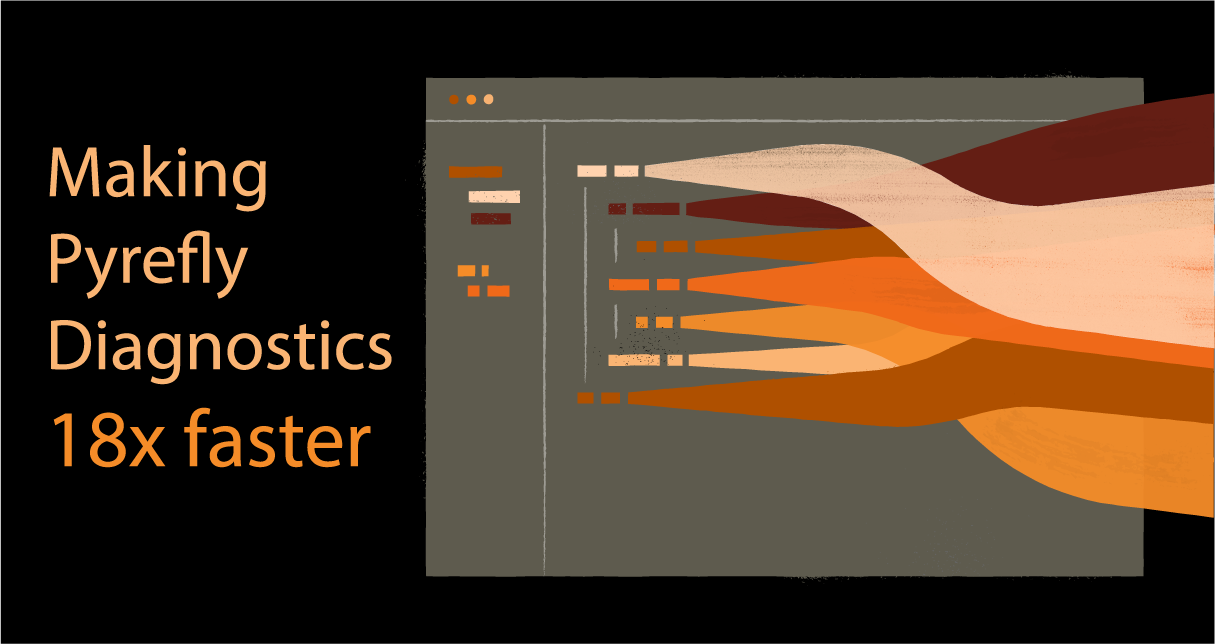
Making Pyrefly Diagnostics 18x Faster

· 7 min read

Hero image

As we move closer to a stable release of Pyrefly, our efforts have moved from expanding the language server’s capabilities to tackling performance edge cases. Recently, our friends at Astral alerted us to a specific edge case that is a great example of the kind of issues we’ve been aiming to uncover. The specific example Astral highlighted showed that in some edge cases Pyrefly could take multiple seconds to update diagnostics after editing. This is much slower than expected (used across Meta’s codebases, Pyrefly usually takes less than 10 milliseconds to recheck files after saving them) and prompted us to investigate further.

Now we’d like to share the story of how that edge case led us to rethink our underlying approach to diagnostics and dependency tracking, improving the speed at which Pyrefly's type errors update by 18x in the process.

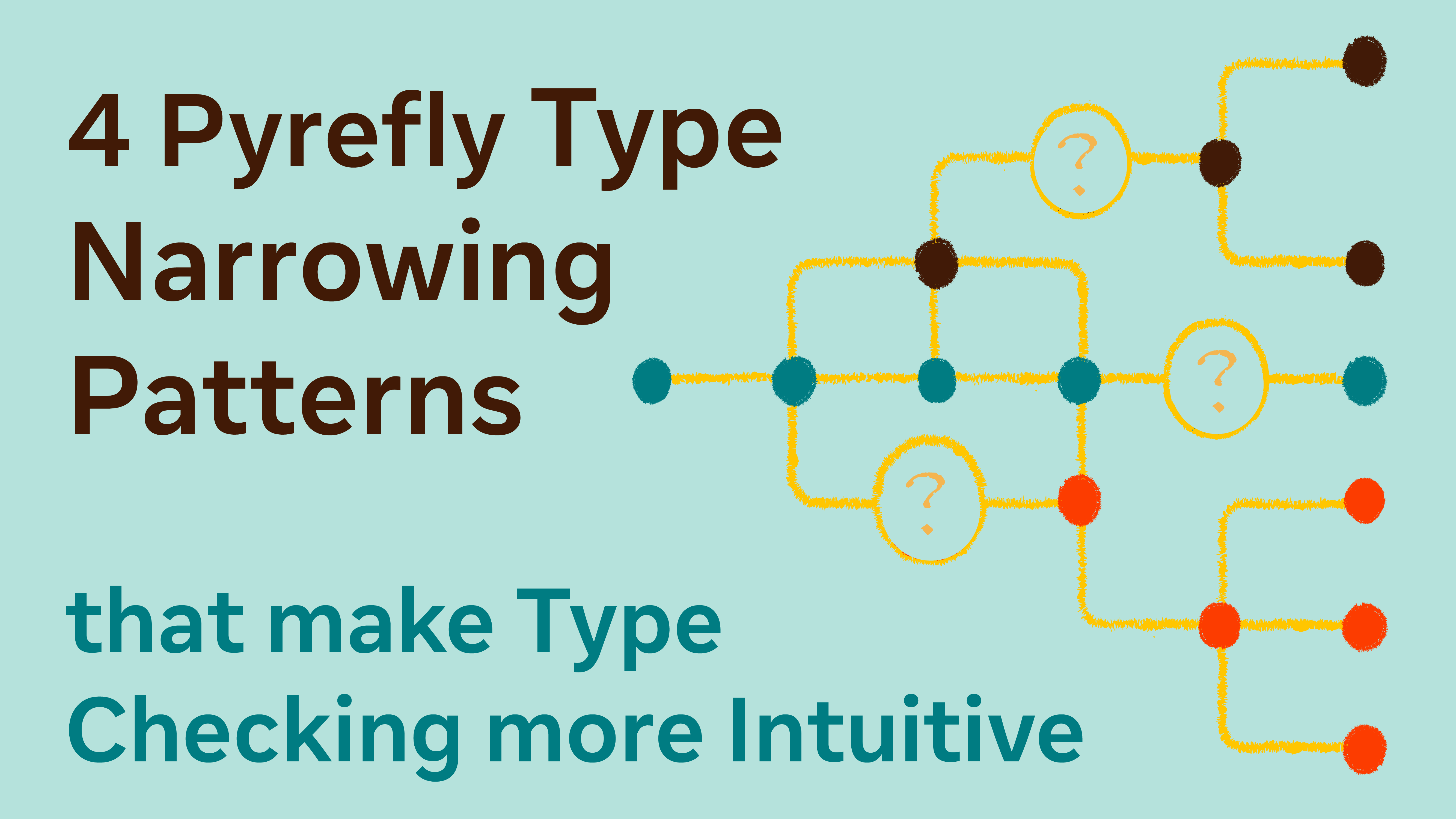
4 Pyrefly Type Narrowing Patterns that make Type Checking more Intuitive

· 4 min read

If we view a type of an expression or variable as the set of possible values it can resolve to, narrowing is the process of applying constraints on those values. For example, if you have a variable x whose contents you don’t know, an if isinstance(x, int) check will narrow the type of x to int inside the body of the if-statement.

Since Python is a duck-typed language, programs often narrow types by checking a structural property of something rather than just its class name. For a type checker, understanding a wide variety of narrowing patterns is essential for making it as easy as possible for users to type check their code and reduce the amount of changes made purely to “satisfy the type checker”.

In this blog post, we’ll go over some cool forms of narrowing that Pyrefly supports, which allows it to understand common code patterns in Python.

Pyrefly Beta is here!

· 9 min read

Today we’re thrilled to announce that we have reached Beta status for Pyrefly, our open-source, high-performance tool for Python code navigation and type checking! We first announced Pyrefly back in April 2025, and thanks to incredible community feedback and a ton of work from our team, we’ve hit a significant milestone.

Bringing NumPy's type-completeness score to nearly 90%

· 7 min read

Because NumPy is one of the most downloaded packages in the Python ecosystem, any incremental improvement can have a large impact on the data science ecosystem. In particular, improvements related to static typing can improve developer experience and help downstream libraries write safer code. We'll tell the story about how we (Quansight Labs, with support from Meta's Pyrefly team) helped bring its type-completeness score to nearly 90% from an initial 33%.

Give your Python IDE a Glow-Up with Pyrefly

· 7 min read

The challenges of managing ever-growing codebases are hardly new. As far back as 1995, Niklaus Wirth, (creator of programming language Pascal) already emphasized the importance of keeping software lean in his essay A Plea for Lean Software. Fast forward to today: many programmers still face the reality that, despite their best coding intentions, as projects grow in size and complexity, so do their codebases. Even when a project scales to millions of lines of code, developers still expect their IDE to be fast, accurate, and efficient. And with increasingly large and interconnected (dare I say, spaghetti?) code, you probably rely on your IDE even more to help you navigate the chaos (ahem I mean complexity).

Why Today’s Python Developers Are Embracing Type Hints

· 11 min read

Python is one of the most successful programming languages out there, with it recently overtaking Javascript as the most popular language on GitHub, according to the latest GitHub Octoverse report. The report emphasises the popularity of the language in the growing fields of AI, data science and scientific computing - fields where speedy experimentation and iteration are critical, and where developers are coming from a broad range of STEM backgrounds, not necessarily computer science. But as the Python community expands and projects grow from experiments to production systems, that same flexibility can become a liability.

That’s why today we’re going to talk about typed Python - what it is, why it’s become important for Python developers today, and how to get started using it to write higher quality, more reliable code.

Introducing Pyrefly - A new type checker and IDE experience for Python

· 5 min read

Pyrefly Intro

Today we are announcing an alpha version of Pyrefly, an open source Python typechecker and IDE extension crafted in Rust. Pyrefly is a static type checker that analyzes Python code to ensure type consistency and help you catch errors throughout your codebase before your code runs. It also supports IDE integration and CLI usage to give you flexibility in how you incorporate it into your workflow.